
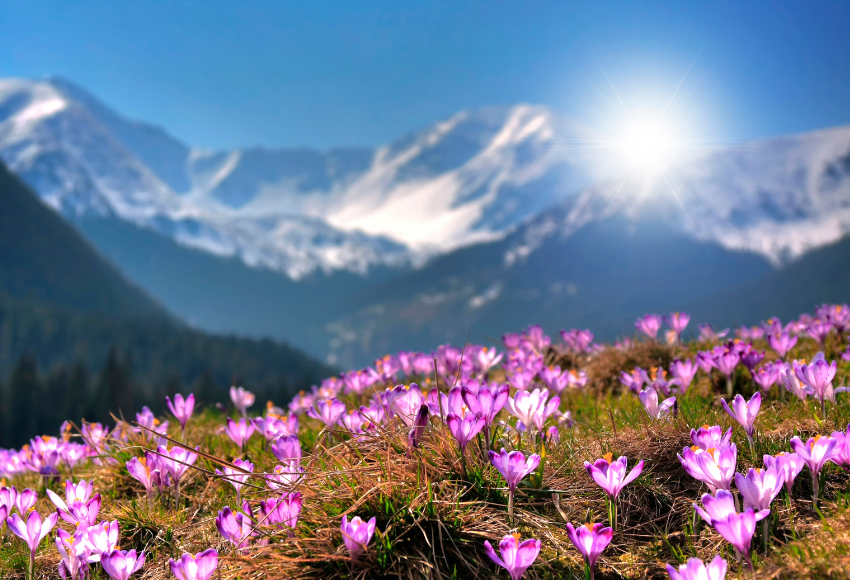
The sun is shining, the birds are singing, and ice cream stands are opening in the city. It seems like winter is finally over. But spring has a different pace in the mountains. Instead of blooming trees, you often find wet slush, icy crust, or a wind that reminds you that bringing a jacket wasn't such a bad idea.
Spring mountains are beautiful. Quiet, peaceful, without crowds. But they are also treacherous. The snow does what it wants, the weather ignores forecasts, and avalanches don't ask if it's April yet.
Why spring is treacherous: Avalanches, icy snow, changeable weather and other pitfalls
You could be scraping ice off your car windshield in the morning and sweating on a slope by noon. And while conditions may seem mild, they can actually be dangerously unpredictable. Here are the main risks you could face and ways to avoid them:
Changeable weather – four seasons during the day
Blue sky in the morning, fog at noon, snowfall in the evening - this is what typical spring mountains look like.
How to best protect yourself:
- Follow the current weather forecast from multiple sources (e.g. Windy, Aladin, SHMÚ).
- If possible, check webcams in the area you are heading to.
- Bring extra layers of clothing, including a waterproof jacket and hat, even if the sun is shining in the morning.
- Plan an escape route – a path you can safely return to in case of a change in weather.
Falling rocks and ice
As the snow melts, not only avalanches but also rocks and chunks of ice are released from the walls and slopes, sometimes without warning.
How to best protect yourself:
- Don't climb steep walls in the afternoon.
- Observe the terrain – if you see a fall mark, go the other way.
- It's better not to stop in risky areas.
Avalanches – a silent and swift danger
In spring, the main threat is wet avalanches that are released spontaneously, especially in the afternoon on sun-warmed slopes. You don't even have to make a mistake - the avalanche can go down on its own.
How to best protect yourself:
- Set out early in the morning when the snow is still frozen and stable. Avalanche risk increases in the afternoon.
- Follow the avalanche level (1-5) on the official website of the Mountain Rescue Service or Alpine Avalanche Centers. (Ideally, it should not exceed level 2.)
- Avalanche news : laviny.cz , avalanche.sk , alpenverein.at
- Avoid steep slopes (30° or more), especially if they are sunny or have fresh or wet snow.
- Bring an avalanche kit.
Icy snow – ice trap
The hard firn in the morning can be like glass. A little carelessness is enough to slide you dozens of meters down.
How to best protect yourself:
- Use crampons and an ice axe – this is not “climbing equipment”, but a necessity if you are walking on frozen snow.
- Plan your route so that you can move on icy sections as early as possible in the morning, when the snow is stable and not as slippery as during the afternoon melt.
- If you are not experienced in moving on hard firn, don't go alone, take a more experienced friend with you or consider a guided hike.
There's more than one type of snow: What types await you in spring and what they mean to you
Spring mountains often offer you all kinds of snow in one day – from frozen firn to wet slush that you’re knee-deep in. Each type has different risks and requires a different approach.
Firn – morning solid snow
- Frozen snow that is hard and load-bearing. It's great to climb on in the morning, often holding up even without crampons. But after a few hours of melting, it becomes slippery, so you can be in danger of a dangerous fall.
- Recommendation: Suitable for early ascent, always ideally with crampons and an ice axe.
Wet snow – afternoon porridge
- When the sun starts to warm up, the firn softens and turns into a heavy slush. For you, that means tiring climbing and the imminent risk of a wet avalanche.
- Recommendation: Descend early, avoid steep slopes.
Icy snow – an invisible danger
- When wet snow freezes in the evening, it forms an icy crust that is extremely slippery and hard. It is very difficult to walk on and a fall can be fatal.
- Recommendations: Crampons, ice axe, avoid steep sections.
Old snow and hardened avalanche fields
- A hard and often uneven surface at lower elevations or in the shade, it is a fairly stable surface compared to other types of snow. However, it is not very comfortable for walking, as it is difficult to pass through.
- Recommendation: Sticks and sturdy shoes, or better yet, avoid it altogether.
Snow bridges and blown snow
- In leeward areas, it covers terrain traps - there is a risk of collapse even without warning.
- Recommendation: Test with a stick, stick to the marked path.
So when is it safe to go?
It is not possible to determine the exact date of the beginning of the spring season, the decisive factor is:
Snow stability and avalanche situation
Before each hike, check how much snow is still in the area, what type of snow it has (wet, hard, firn) and whether there is a risk of avalanches. Even if everything is blooming in the valley, there can be meters of unstable snow at higher altitudes.
Orientation of slopes
Eastern and southeastern slopes – ideal for climbing
The sun shines on them early in the morning, so the snow softens earlier than elsewhere, but it is still sufficiently load-bearing and stable. It is good to start climbing early in the morning, when the snow is still hard, and return before it softens.
Southern and southwestern slopes – watch out for wet avalanches
They get the most sun in the spring, so the snow softens quickly and unstable layers are easily loosened. This creates the risk of avalanches from heavy wet snow. Either get on these slopes very early or avoid them altogether.
Northern slopes – snow lasts longer, but can be icy
The sun gets here minimally in the spring months and for that very reason the snow melts slowly and is often hard and slippery. Thanks to this, there is not such a risk of wet avalanches, but on the contrary there is a high risk of slipping on the icy surface, especially in the morning. Therefore, the northern slopes are more suitable for experienced skiers equipped with crampons and an ice axe.
Western slopes – a compromise, but watch out for the afternoon
They start to soften later in the day, so they tend to be stable longer than the south. If you're on the west slope late in the afternoon, the snow may already be soft and there is a risk of wet avalanches.

Current weather and forecast
As in every season, the weather in the mountains is very unpredictable in spring. Clear skies in the morning do not mean that there will be no storm in the afternoon. At higher altitudes, sudden winds, fog or snowfall may occur, even though it is summer in the lowlands. There is also a risk of large temperature differences, so it is a good idea to follow the current forecast from several sources (Windy, Yr.no, Aladin) and take appropriate equipment.
Equipment specific to spring conditions
Spring mountains are a mix of winter and summer, and your equipment should match.
Shoes and clothing
- Sturdy, waterproof boots – ideally ankle boots with a harder sole, able to handle snow, ice and mud.
- Shoe covers – protect against getting wet from melting snow.
- Functional clothing in layers – basic, insulating and protective layer (e.g. merino T-shirt, fleece, hardshell jacket).
- Spare dry clothes – T-shirt, underwear, socks, hat – in a backpack in a waterproof bag.
- Gloves (and spare ones) – ideally waterproof with thermal insulation.
- Hat and multifunctional scarf – protects against cold and sun.
Technical equipment
- Crampons – iron, fit well on your shoes, suitable for icy sections.
- Ice axe – an ideal lightweight tourist model, used for climbing and self-protection in case of a fall.
-
Telescopic poles – help with balance on varied terrain, adjustable according to slope.
-
Sunglasses with a UV filter – snow reflects strong UV radiation, there is a risk of snow blindness.
High factor sunscreen (SPF 30–50) – ideal for lips too.
Avalanche equipment (if you are going into avalanche terrain) :
- Beep (avalanche locator)
- Probe
- Shovel .
Recommendations for safe spring routes
Search for routes:
- Shorter, with the possibility of retreat
- No avalanche slopes
- Up to 2500 m above sea level, ideally marked and clearly marked
The spring mountains have a unique charm. They offer silence, beauty, stable firn and views without crowds. But they also know how to torment. If you give them respect, prepare and set off on time, they will reward you with an experience that will not be forgotten. Because while others are waiting for summer, you can already be on the ridge.

Leave a comment
All comments are moderated before being published.
This site is protected by hCaptcha and the hCaptcha Privacy Policy and Terms of Service apply.